PAST
In 1906 Gaudí was 54 years old. That year his father, Francesc Gaudí, died. The loss was not only emotional: Francesc was his everyday support. Antoni went on living in the house in Park Güell with the last of his family: his niece Rosa, who was then thirty and already ill with tuberculosis. Rosa died in 1912, the year Gaudí was left completely alone. He never had a romantic partner.
That is when the storm began. First came the commercial failure of Park Güell, a development of 60 houses entrusted to him by Eusebi Güell, of which only two were sold, and he himself bought one. Then came the complicated restoration of La Seu, Palma Cathedral in Mallorca, and the odyssey of building La Pedrera. And always, in the background, the Sagrada Família, growing amid economic and technical difficulties. Resources were scarce, the canons of Mallorca were wary of his decisions, and Gaudí kept raising towers for a silent God.
In 1909 the legal troubles over La Pedrera erupted: the Milà-Segimons disputed Gaudí’s fees. The masterpiece then became a legal battlefield. With it almost finished, Gaudí had to abandon it, and that same year Barcelona burned in the Tragic Week: an anticlerical revolt, barricades, convents stormed, the corpses of clergy exhumed and twenty-three churches set ablaze. The city that Gaudí was transforming into sacred architecture went up in flames. And in the midst of that inferno, the Sagrada Família still stood, unfinished, like a stone skeleton that no one dared to touch and that Gaudí feared they would destroy.
His work was an act of resistance, but more than fear, what pained him were the injustices done to the poor. And so another sculpture was born in the niche of the Amen of the Hail Mary, in the inner cloister of the Sagrada Família: the sculpture of a young woman who hesitates when offered money to prostitute herself, and of a worker who hesitates before an Orsini bomb. Both are tempted; both may be suffering, unsure what to do, swept along by hard, objective circumstances: poverty, illness, exploitation. Neither has made the decision yet. The two sculptures look toward Mary, who presides over that corner of the cloister. Gaudí does not decide for them: he only suggests. Trust in your Mother, but you decide. Both stand in full view of all. Not as a condemnation, but as a warning. As an invitation to reflect.
Because Gaudí knew that God leaves us a path: free will. And that is also the invitation to keep building what he began. To trust even when you do not understand. To love even when you receive nothing in return. To build even when you cannot see the end.
And here something happened that put everything to the test. In 1911, Gaudí falls gravely ill. Malta fever drives him to write his will, out of the need to set down in writing what his last wishes will be. In the darkest night, a book comes into his hands: Saint John of the Cross, a reading that fills him with understanding and, above all, reaffirms his path. Miraculously, he does not die; and if the last time he came through with a vision, now he comes through with a mission. Instead of withdrawing, of protecting himself, of building higher walls, Gaudí builds, out of his own pocket, a school to welcome with open arms the poorest of the poor: their children.
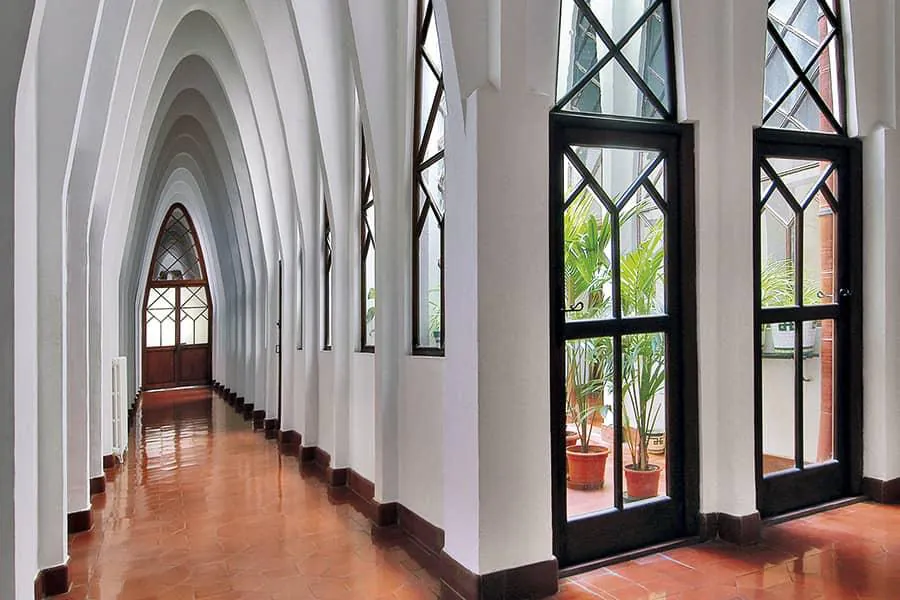
The Sagrada Família Schools are a modest, functional, unadorned building. They are intended for the children of the workers building the temple and for children from the neighborhood. Gaudí himself designs the school so that the children have a place to learn, to grow, to receive an education that might keep them away from violence.
The logic behind this is simple and profound: if ignorance and misery have driven men to burn churches, education and dignity will lead them to build cathedrals. Gaudí gives up his fees as architect of the Sagrada Família. He begs for alms to continue the work. And he devotes what little he has to giving the workers’ children a future.
The Schools are Gaudí’s answer to the fire, to the violence. He does not condemn: he builds. It is the gesture of a man who, amid the ruin, chooses to sow. When the city burned, he responded with classrooms. Where others saw rubble, he laid foundations.
José Manuel Almuzara shows us how Gaudí did not just design the Sagrada Família: he designed a method, a system, an architecture full of symbols and geometries. He takes us along the Nativity façade, with its enigmas and its messages. Here we discover that the work is not only architecture; it is theology in built form. And then he recalls a detail that says it all. Le Corbusier, father of modern architecture, on seeing the floor plan of the school Gaudí built, discovered the perfect geometry of three hearts that Gaudí had left in it.
They are not decoration. They are the structure that holds up the roof. Three hearts, three classrooms dedicated to Jesus, Mary and Joseph, with a pillar at the center of each heart, and these are what keep everything else standing. For Gaudí, love is not a feeling: it is structure. It is what holds things up. It is what allows the work to endure. And so, even the roof rests on love.
And then, the connection: in Gaudí’s work there is a message of founding love. Love of God is the structure that gives meaning to everything he builds: love. Without it present, his work is a body without a soul.
T H E E N D.
By the end of this second episode, the viewer has seen a mature Gaudí at his darkest moment: the death of his father, the failure of some of his projects, the fire over his city and the sculpture that never got to crown his secular work. But they have also seen what is decisive: a man who, in the midst of fire, builds schools; in the midst of failure, keeps believing; in the midst of loss, finds meaning. Rebuilding through love. That is his transformation and his invitation: to believe when all seems lost, to love without fear.
CLIFFHANGER
Here we reach the heart of our mystery. The narrator offers a reflection. Gaudí could not finish La Pedrera as he had originally conceived it. In his way stood a war, a lawsuit and the fear that the whole building would be burned. Why?
Gaudí conceived the Casa Milà building as a gigantic pedestal for a monumental sculpture celebrating the purest, most unconditional love: the love of Mary. At the top, above the chamfered corner, was to stand a sculptural group of Our Lady of the Rosary, 4.5 meters tall, flanked by the archangels Michael and Gabriel, in stone, gilded metal and glass, which was never able to take its place.
José Manuel Almuzara reveals to us how Gaudí commissioned the model of the sculpture from the sculptor Carles Mani. The site was ready. Gaudí had even carved the inscription into the cornice: Ave Gratia Plena Dominus Tecum. And in the center, a rose and an “M” for Mary, where it was to be placed, but the sculpture was never put in place. In the climate of the Tragic Week, a building crowned by a Virgin almost 5 meters tall was an invitation to attack. Twenty-three churches had already burned. The owners did not want La Pedrera to be the twenty-fourth. Gaudí was saddened; he said that, had he known the sculpture would not be installed, he would not have accepted the commission. He entered into litigation with the owners of Casa Milà, and that is how it was left without its last stone. Without the crowning piece that gave it meaning. Without the Virgin that was to crown the last secular work. Without the founding love of his faith.
The last stone was not an ornament. It is the meaning of the entire work. But is there a sketch? What figure did Gaudí imagine, and where did it end up? That is what we are going to find out.